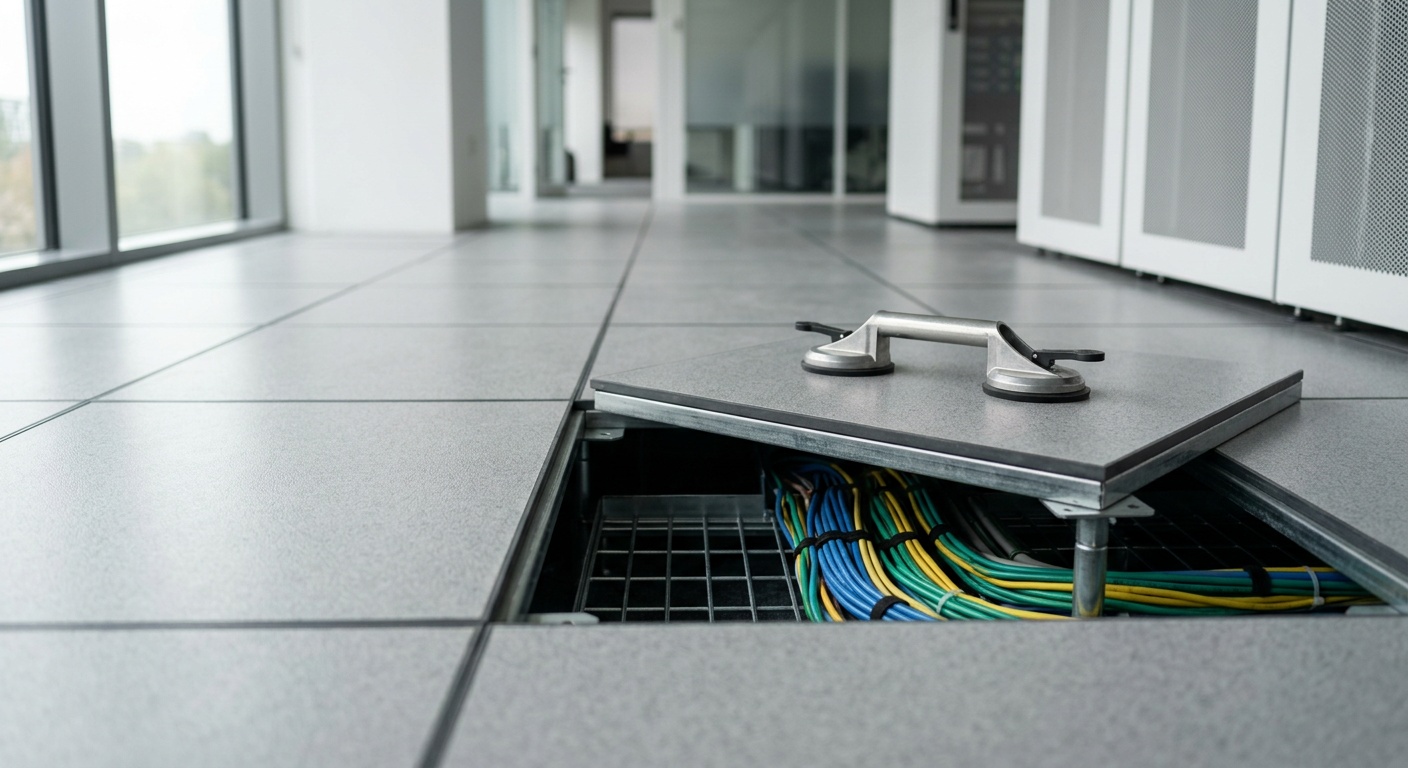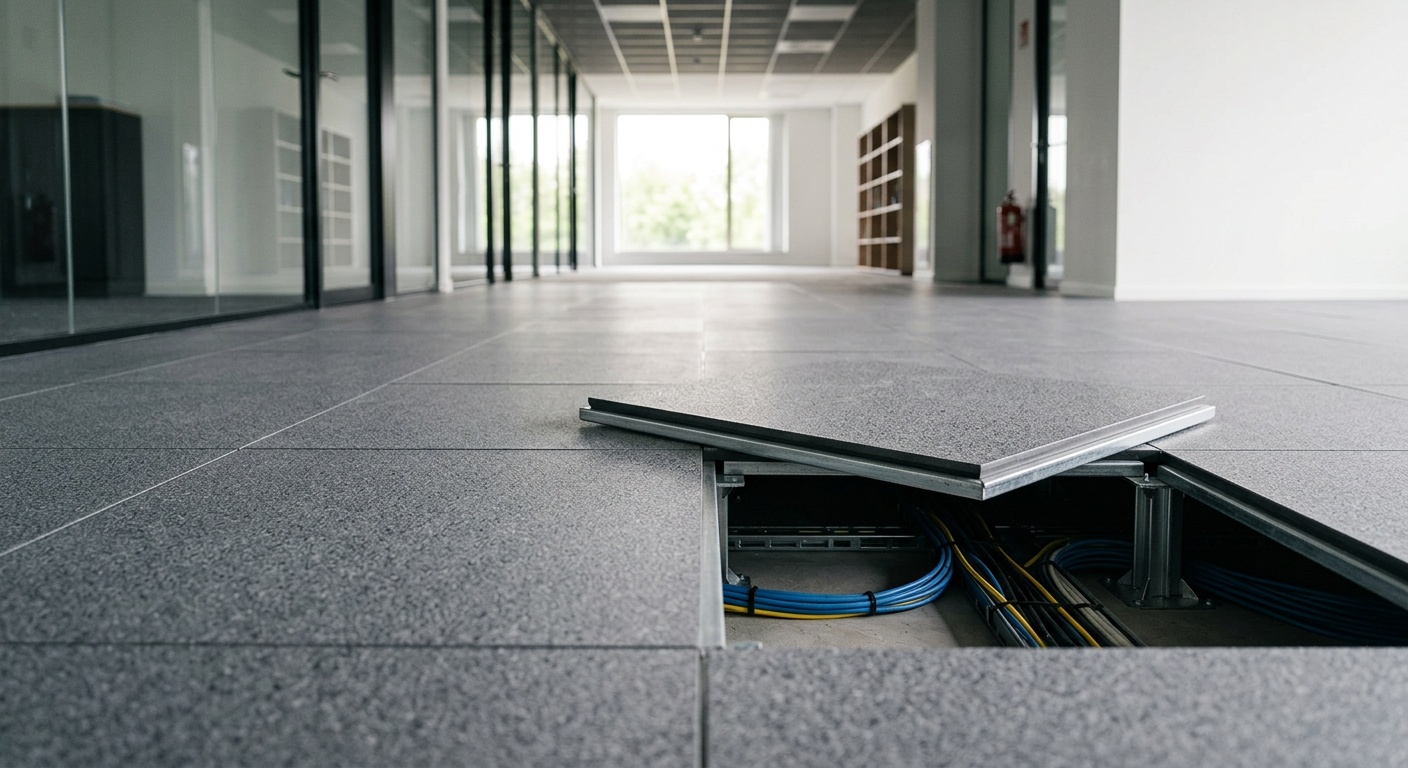
Choosing the Right Panel Thickness for Server Room Floors: A Data Center Manager’s Guide
Reading time: 8 minutes
You’ve got racks arriving next week, a budget spreadsheet that’s already tighter than you’d like, and a flooring contractor asking one deceptively simple question: “What gauge panels do you want?” If you’ve ever paused before answering that, this guide is for you.
Table of Contents
- Why Panel Thickness Actually Matters
- Understanding Load Ratings and Server Weight
- Common Panel Thickness Options Compared
- Real-World Scenarios and Lessons Learned
- Making the Final Decision
- Frequently Asked Questions
Why Panel Thickness Actually Matters
Here’s the straight talk: raised access flooring isn’t just a platform to walk on—it’s a structural system that has to survive decades of rack rolls, technician foot traffic, and increasingly, the sheer weight of modern high-density compute. In 2026, with AI training clusters pushing rack densities past 40kW and GPU-dense enclosures routinely exceeding 1,500 kg fully loaded, the margin for error in floor specification has shrunk considerably.
Panel thickness isn’t an isolated variable. It works in concert with core material (calcium sulfate, cementitious woodcore, or die-cast aluminum), understructure grid spacing, and pedestal height. But thickness is often the first number engineers gravitate toward, and it’s the one that most directly correlates with concentrated load capacity and deflection resistance.
Industry veteran Rajiv Mehta, a facilities engineer who has overseen flooring installations for three hyperscale campuses in Northern Virginia, puts it bluntly: “I’ve seen operators save $40,000 on a flooring package and then spend triple that two years later ripping it out because a panel cracked under a fully loaded server rack being wheeled across it. Thickness is cheap insurance.”
The Hidden Cost of Under-Speccing
Undersized panels don’t usually fail catastrophically on day one. They fail slowly—through micro-deflection, hairline cracking, and creeping instability that shows up as uneven tiles, rattling underfoot, or worse, airflow leakage in your hot/cold aisle containment. According to a 2025 survey by the Uptime Institute, roughly 14% of unplanned data center outages involving physical infrastructure traced back to flooring or subfloor issues that had gone unaddressed for years.
The Overspend Trap
On the flip side, over-speccing isn’t free either. Heavier, thicker panels increase dead load on the building structure, can complicate cable routing height, and inflate procurement costs by 20-35% compared to standard-grade options. The goal isn’t “thickest possible”—it’s “correctly matched to your actual and projected load profile.”
Understanding Load Ratings and Server Weight
Before you can pick a thickness, you need three numbers: static uniform load, concentrated load, and rolling load. Most manufacturers rate panels in these three categories, and thickness is usually the lever that shifts all three simultaneously.
- Static uniform load – how much weight per square foot the floor can bear evenly distributed.
- Concentrated load – the weight a single point (like a rack leg or caster) can bear without permanent deformation.
- Rolling load – critical for anyone wheeling racks, lift equipment, or pallet jacks across the floor during installs.
A quick scenario: imagine you’re deploying a row of liquid-cooled GPU racks weighing 1,800 kg each, with a footprint of roughly 600mm x 1200mm. That concentrated load at the caster points can exceed 500 kg per contact patch during a rolling move. A standard 28mm calcium sulfate panel rated for 1,000 lb concentrated load might pass on paper for static placement but fail under dynamic rolling stress. This is exactly the kind of gap that catches teams off guard.
Common Panel Thickness Options Compared
Here’s how the most widely used panel thicknesses stack up in real deployment conditions. These figures reflect typical calcium sulfate and steel-encapsulated panels sold by major manufacturers in 2026.
| Panel Thickness | Typical Concentrated Load | Best Suited For | Relative Cost Index |
|---|---|---|---|
| 25mm (1 inch) | 600-800 lb | Light office/network closets, low-density labs | 1.0x (baseline) |
| 28-32mm | 1,000-1,250 lb | Standard enterprise server rooms | 1.3x |
| 36-40mm | 1,500-2,000 lb | High-density colocation, mixed workloads | 1.7x |
| 45mm+ / steel-encapsulated | 2,500-3,000+ lb | AI/GPU clusters, liquid cooling infrastructure | 2.4x |
| 50mm aluminum die-cast | 3,000+ lb | Mission-critical, seismic zones, hyperscale | 3.1x |
Visualizing Load Capacity by Thickness
The relationship between thickness and concentrated load capacity isn’t perfectly linear, but the trend is clear. Here’s a simplified comparison based on average manufacturer ratings:
Real-World Scenarios and Lessons Learned
Case Study: The Colocation Retrofit That Almost Went Wrong
In early 2025, a mid-sized colocation provider in Austin was retrofitting a 15-year-old facility to accommodate new AI-inference clients. The existing 28mm panels had served fine for years of standard 1U/2U server deployments. When the first GPU racks arrived—each tipping the scales at 1,400 kg—the facilities team ran a load audit before installation, discovered the concentrated load rating fell short by nearly 40%, and swapped in 40mm steel-encapsulated panels along the primary rack rows before a single unit was powered on. The retrofit added roughly three weeks and $85,000 to the project, but it avoided what the site’s chief engineer called “a very expensive floor collapse we’d have discovered the hard way.”
Case Study: Overbuilding in a Low-Density Environment
Contrast that with a regional healthcare provider that specified 45mm panels throughout a modest server room supporting only virtualized file and print services—loads that never exceeded 400 lb concentrated. The result wasn’t disaster, just waste: a procurement overspend of nearly $22,000 for capacity the room would never use, plus added structural loading calculations that delayed permitting by six weeks. Balance matters in both directions.
Making the Final Decision
So how do you actually land on the right number? A few practical steps:
- Audit your heaviest current and projected equipment – Don’t just look at today’s racks; factor in what you’ll deploy in the next 5-7 years, especially if AI or HPC workloads are on your roadmap.
- Request concentrated and rolling load data, not just static uniform load, from your flooring vendor. Static numbers alone hide the real risk.
- Match pedestal spacing to panel thickness – a thicker panel on widely spaced pedestals can still underperform a thinner panel on tighter grid spacing.
- Factor in seismic and building code requirements if you’re in a zone with elevated structural standards—thickness requirements often increase automatically.
- Get a structural engineer’s sign-off for anything above 15kW per rack density. This isn’t optional anymore in most jurisdictions.
Pro Tip: Always test-fit a sample panel with your actual rack casters before finalizing an order. Manufacturer spec sheets are a starting point, not a guarantee—real-world contact geometry can shift load distribution more than people expect.
Frequently Asked Questions
Do thicker panels always mean better performance?
Not necessarily. Thickness matters, but core material and pedestal support system matter just as much. A well-engineered 32mm steel-encapsulated panel can outperform a poorly supported 40mm calcium sulfate panel. Always evaluate the whole system, not just one spec.
How often should existing server room floors be reassessed?
Most facilities engineers recommend a load reassessment every time equipment refresh cycles bring in meaningfully heavier hardware—typically every 3-5 years—or immediately when transitioning to high-density or liquid-cooled deployments.
Is it possible to reinforce existing panels instead of replacing them?
In some cases, yes. Adding secondary understructure support or upgrading pedestal density can extend the usable life of existing panels. However, once a panel shows visible deflection or cracking, replacement is almost always safer and more cost-effective than reinforcement.
Your Roadmap Forward: Flooring That Won’t Hold You Back
As data centers push further into AI-driven density and liquid cooling infrastructure through 2027 and beyond, floor specification is no longer a background decision—it’s a core part of capacity planning. Here’s your practical checklist to move forward with confidence:
- ✅ Document current and projected rack weights before contacting flooring vendors
- ✅ Request concentrated and rolling load ratings, not just static figures
- ✅ Match panel thickness to your densest anticipated deployment, not your average one
- ✅ Involve a structural engineer for any density above 15kW per rack
- ✅ Reassess flooring capacity at every major hardware refresh cycle
The right panel thickness isn’t about buying the biggest number on the spec sheet—it’s about building a floor that quietly does its job for the next fifteen years, regardless of what hardware evolution throws at it. So before your next flooring order goes out, ask yourself: is this floor built for the servers you have, or the ones you’ll actually be running in three years?